Highway Wide‑Area Traffic Detection System
Radar-Video Fusion,Edge Computing,Incident Linkage,Second-Level Alerting
Expressway traffic operations today face the triple challenges of high volume, high speed, and high risk. Traditional video monitoring is susceptible to weather and lighting, leading to low recognition rates and frequent false/missed alarms. Incident handling relies on manual detection, often missing the optimal response window. Massive trajectory data cannot be quickly analyzed, constraining safety management.
Our system uses millimeter wave radar as the core sensing technology to continuously track vehicle trajectories, speed, and behavior in all weather conditions. It automatically detects abnormal stop, reverse, congestion, lane change, and other incidents within seconds, generates alerts, and pushes information to VMS and broadcasting devices — forming a complete closed loop of “sensing – alert – handling – archiving.” Radar based perception ensures reliable, real time incident detection and rapid response, significantly improving expressway safety and emergency efficiency.
Accurate, real-time traffic sensing is the foundation for proactive expressway safety management. Conventional video-based systems are often limited by weather conditions, lighting variations, and restricted field of view. Radar-video fusion offers a robust and reliable alternative, providing all-weather vehicle trajectory, speed, and behavior data. It enables second-level incident detection and automatic alerting, reducing response time and improving emergency handling efficiency. Moreover, radar-video fusion requires no additional infrastructure, integrates easily with existing systems, and provides a cost-effective path for expressway safety upgrades.
System Architecture
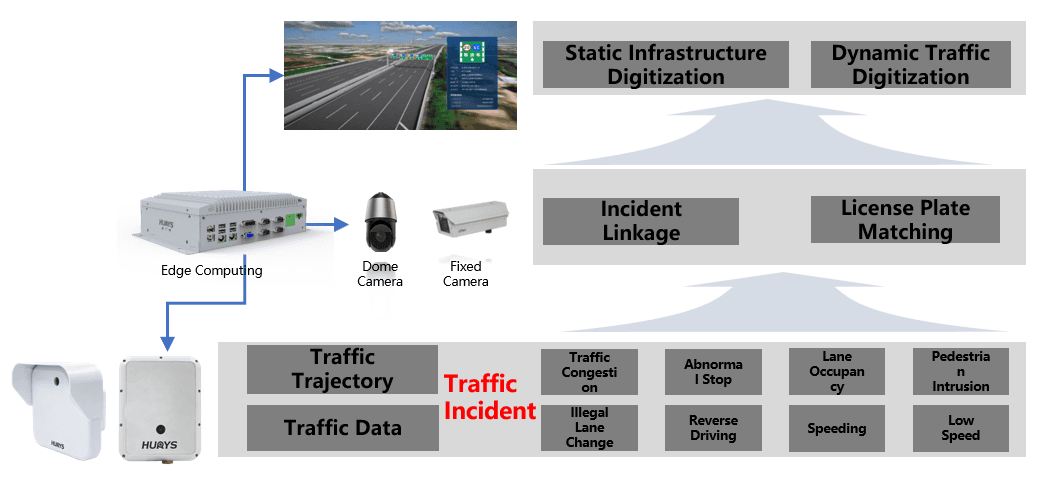
The system adopts a three-tier closed-loop architecture — Sensing, Edge Computing, and Application — to enable integrated incident linkage and rapid response.
• Sensing layer– Millimeter-wave radar and HD video are fused. Radar collects vehicle position, speed, heading angle; fixed cameras extract license plate, vehicle type, and other visual features; dome cameras handle incident evidence capture — forming an all-weather multi-source sensing network.
• Edge computing layer – Built-in intelligent algorithms complete incident assessment within milliseconds, triggering radar-dome linkage for automatic snapshot evidence capture. Structured data is uploaded to the platform in real time, enabling rapid edge response and coordinated in-depth analysis at the center.
• Application layer – The platform presents macroscopic network situations via digital twin, supports full-process incident closed-loop handling, and triggers alerts through VMS and broadcasting — forming a fast closed loop of "sensing – assessment – evidence – alert – handling – archiving."
Challenges and Applications
Expressways face multiple challenges due to the limitations of traditional monitoring approaches.
-
Video monitoring is susceptible to weather and lighting, causing low recognition rates and frequent false/missed alarms
-
Incident handling relies on manual detection and reporting, missing optimal response windows
-
Sensing, decision-making, and dissemination are fragmented, lacking efficient coordination
-
Massive trajectory data cannot be quickly analyzed, and abnormal behavior mining lags behind
-
Limited all-weather sensing capability constrains safety management and emergency response These challenges call for radar-video fusion-based sensing to enable proactive, data-driven expressway safety management.
Applications
1、Traffic data sensing – Continuously outputs lane-level trajectory data (position, speed, heading angle, acceleration) for full vehicle tracking and path reconstruction. Provides multi-section statistics: traffic volume, speed, occupancy, headway, etc. Outputs area status data including vehicle count, space occupancy, and distribution coefficient — building a precise data foundation for network monitoring and situation assessment. 2、Traffic incident sensing – Based on radar-video fusion, achieves all-weather accurate identification and second-level alerts. Incident types include: abnormal stop, overspeed/underspeed, reverse drive, illegal lane change, congestion, pedestrian intrusion, and non-motor vehicle intrusion. 3、Incident linkage handling – Once the radar locks onto an incident, it generates target information and pushes it to the edge computing unit. The edge unit drives the dome camera to automatically pan, tilt, and zoom for HD video and snapshot capture. Radar trajectory and video stream are fused to generate a structured incident package. The package is uploaded via dedicated network to the management platform for automatic categorization and archiving, supporting multi-dimensional retrieval and playback for accident accountability and traffic analysis.
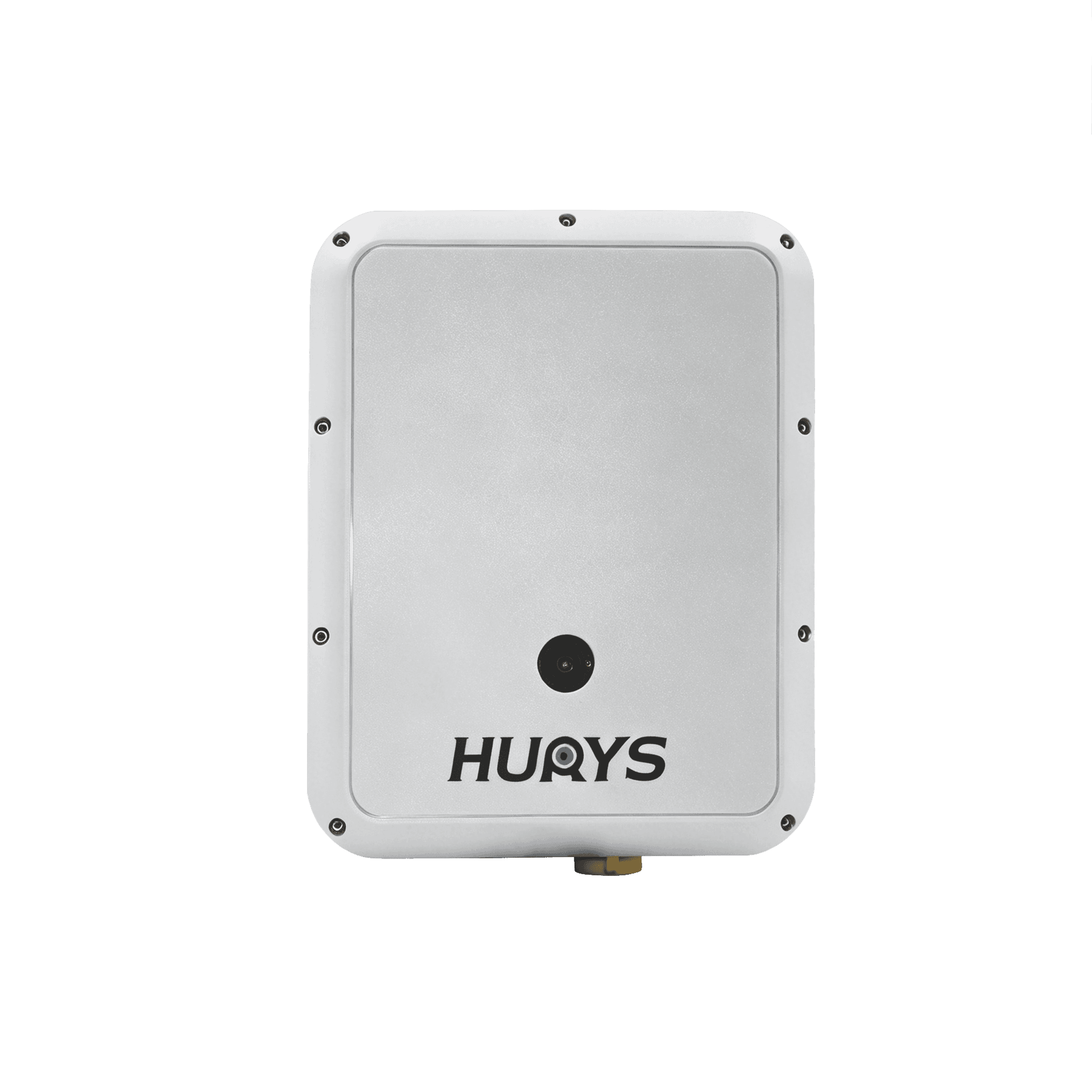
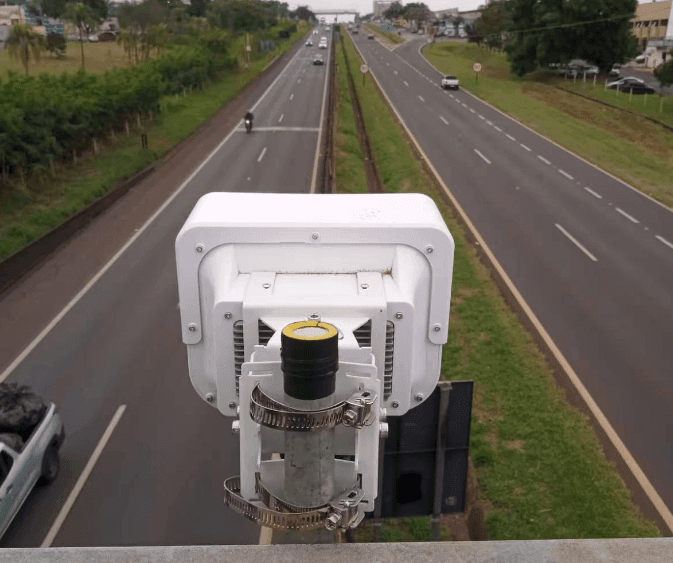
Product Portfolio For Expressway Incident Sensing System
All-Weather, Wide-Area, High-Precision Sensing The system leverages millimeter wave radar and HD video fusion to deliver all weather, wide area, and high precision detection of vehicle trajectories, speed, and behavior – unaffected by rain, snow, fog, or darkness. Radar provides continuous, long range coverage across multiple lanes, outputting real time position, speed, heading angle, and other motion data with decimeter level accuracy. Video synchronously captures visual features such as license plate and vehicle type for precise classification. The fusion of radar and video ensures reliable, high confidence detection over a large area, building a complete, real time data foundation for incident detection and proactive safety management.
Incident Detection and Closed Loop Handling The system continuously monitors expressway traffic and automatically detects incidents such as abnormal stop, illegal lane change, overspeed, underspeed, congestion, and unauthorized intrusion. Upon detection, it triggers alerts, captures evidence, generates an incident report, and pushes warnings to VMS and broadcasting devices while notifying road administration, police, and rescue teams—forming a complete closed loop of detection, alert, response, and archiving.
Problems We Solve in Expressway Incident Sensing System
Conventional expressway monitoring relies heavily on video systems, which are susceptible to weather and lighting conditions — resulting in low recognition rates for subtle abnormal behaviors and frequent false/missed alarms. Incident handling depends on manual detection and reporting, often missing the optimal response window. Sensing, decision-making, and dissemination are fragmented, lacking efficient coordination. Massive trajectory data cannot be quickly analyzed, and abnormal behavior mining lags behind. HURYS radar-video fusion sensors provide all-weather, high-precision trajectory and behavior data, upgrading expressway safety management from reactive to proactive. 1、Video systems fail in adverse weather – Traditional video monitoring drops in reliability during rain, fog, snow, or nighttime, failing to provide continuous and stable detection for expressway safety. 2、Manual detection misses response windows – Incident handling relies on manual discovery and reporting, causing delays that often miss the optimal response window and increase secondary accident risks. 3、Fragmented systems lack coordination – Sensing, decision-making, and dissemination operate independently, lacking efficient collaboration for rapid incident response. 4、Massive data cannot be quickly analyzed – Large volumes of trajectory data cannot be processed in real time, and abnormal behavior mining lags behind — constraining proactive safety management. 5、No reliable real-time data for incident response – Without fine-grained, low-latency real-time data, incident detection and response lack objective evidence, making rapid and accurate handling unattainable.
Hurys Radar Detectors Enable Proactive Expressway Safety
Hurys radar-video fusion detectors provide real-time vehicle trajectory, speed, and behavior data, enabling second-level incident detection and automated linkage handling. Core Capabilities
-
All-weather accurate sensing – Unaffected by rain, snow, or fog; delivers trajectory and behavior data 24/7
-
Radar-video fusion – Deep integration of radar and video enables comprehensive, reliable incident detection
-
Edge-enabled incident linkage – Millisecond-level assessment, automatic dome camera evidence capture, and structured data output
-
Multi-event detection – Supports abnormal stop, overspeed, reverse, lane change, congestion, and intrusion detection
-
Full closed-loop handling – Sensing – assessment – evidence – alert – handling – archiving, ensuring complete traceability
-
Open interface compatibility – Supports standard protocols for seamless integration with VMS, broadcasting, and management platforms This shifts expressway safety from reactive to proactive — improving incident response time, reducing secondary accident risks, and enabling smarter expressway management.