
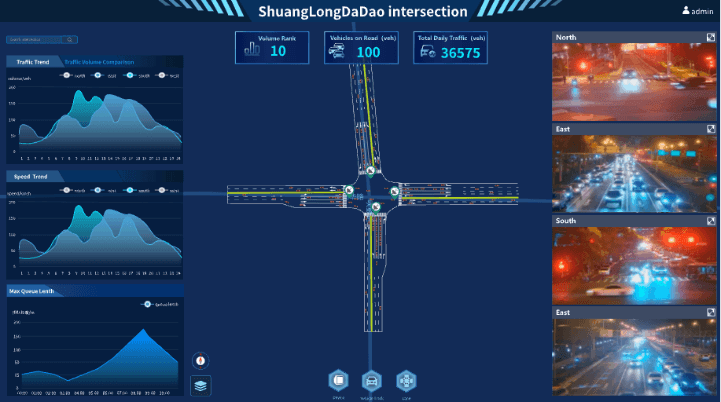
RTP Traffic Data Platform
-
The platform delivers accurate, reliable sensing by unifying radar data collection, storage, analysis and sharing on one middle platform.
-
It realizes all-weather high-precision monitoring via multi-target radar, stable at night and under severe weather.
-
It supports multi-dimensional deep analysis for intersection monitoring, signal evaluation, incident archiving and traffic analysis, converting raw data into visual charts for decision support.
-
It enables open collaboration and data sharing through pub-sub protocols and APIs, breaking data silos to interconnect with external traffic systems.
-
It features flexible, scalable deployment in standalone, lightweight, standard, distributed and cluster modes to meet diverse radar access requirements.
The RTP radar traffic platform is an all-in-one big-data system centered on radar sensing, integrating data archiving, traffic diagnosis, digital twin, and equipment O&M. It supports flow statistics, signal assessment, real-time alerts, and trajectory analysis, driving data‑based optimization of intersection efficiency and safety.
The platform adopts a radar data middle‑layer architecture that unifies collection, storage, analysis, and sharing, breaking data silos. It supports standalone, lightweight, standard, distributed, and cluster deployment modes to flexibly accommodate various access scales, ensuring high performance and scalability.
-
Traffic Situation Awareness Built on radar data and digital twin, it visualizes vehicle trajectories, signal status, flow heatmaps, and real-time counts for full intersection awareness.
-
Intersection Monitoring It tracks queue length, turning rates, and peak hours, displays directional flow and queue curves on dashboards, and supports incident inquiry with closed-loop handling.
-
Signal Evaluation & Optimization It synchronizes signal phases with radar flow data to compute starvation, imbalance, saturation, and congestion indexes, quantifying timing performance for data-driven optimization.
-
Multi-dimensional Analysis It offers modules for flow statistics, traffic assessment, turning analysis, and congestion records, supporting queries by lane, direction, time, and minute granularity, with chart and report exports for in-depth study.
-
Full-lifecycle Device O&M It monitors connectivity, data completeness, and faults in real time, with grouping, alerts, and history queries, shifting maintenance from reactive repair to proactive warning for stable operation.